
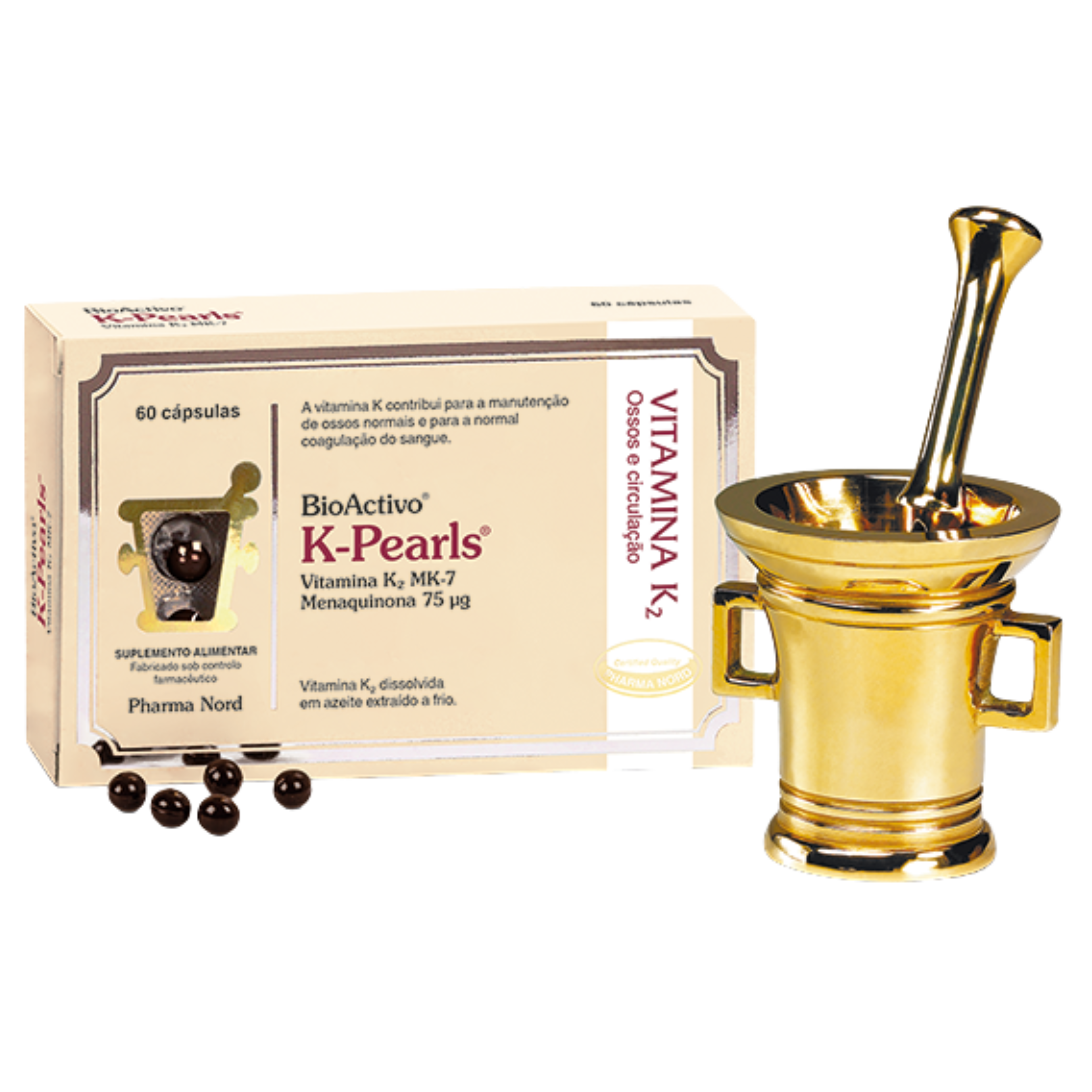
BioActive K-Pearls Vitamin K2 60caps - Pharma Nord
BioActive K-Pearls Vitamin K2 60caps - Pharma Nord Available in stock
Em Stock - 1 unidade disponível
Free Shipping on orders over 30€ (Portugal Continental)
Description
Description
BioActivo K-Pearls Vitamin K2 60caps - Pharma Nord
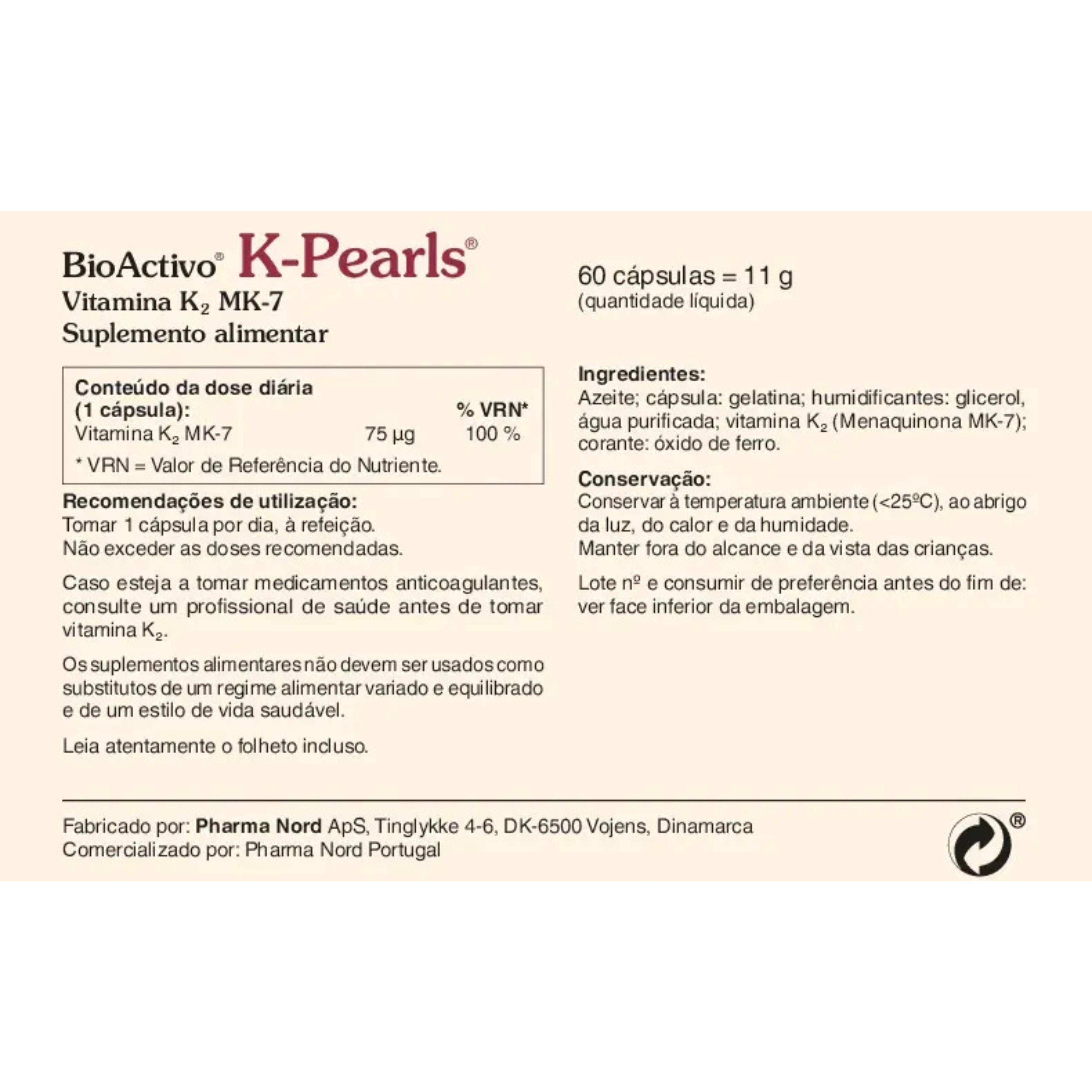
BioActivo K-Pearls from Pharma Nord contains small soft gelatine capsules, with 75 μg of pure vitamin K2 (menaquinone MK-7) in each capsule. The vitamin K2 is dissolved in cold-pressed olive oil, for optimal absorption. The capsules are easy to swallow due to their small size and can also be chewed. BioActivo K-Pearls should be taken with a meal.
Active form of MK-7
Naturally, vitamin K occurs in two structural forms: trans and cis, which are distinguished by the spatial configuration of the molecule. Only the trans form of MK-7 has biological activity. The cis form, in turn, does not show any biological effect.
BioActivo K-Pearls contains exclusively vitamin K2 in the fully trans form, thus guaranteeing its biological efficacy.
What is vitamin K?
Vitamin K belongs to the group of fat-soluble vitamins, which also includes vitamins A, D, and E.
It was discovered in 1929 by the Danish biochemist Henrik Dam, who would go on to receive the Nobel Prize in 1943 for his discovery. The name "vitamin K" derives from the word "Koagulation", a term used in Danish and German to designate the blood clotting process.
Later, two main types of vitamin K were identified: phylloquinone (K1) and menaquinone (K2). There is also a synthetic version, menadione (K3), which is not usually used in food supplements.
Vitamin K2 appears in various forms, ranging from MK-4 to MK-14. However, MK-10 and higher forms occur rarely. The MK designation refers to the length of the molecule's side chain, composed of isoprene units. The forms most used in nutritional supplements are MK-4 and MK-7.

Why vitamin K2 MK-7?
Vitamin K2 MK-7 remains in the body for longer than vitamin K1 and vitamin K2 MK-4. For this reason, the MK-7 form is considered more effective. Both K1 and K2 MK-4 are rapidly metabolized and eliminated by the body, and we have only a small amount of vitamin K stored in the liver, spleen, and lungs.
Vitamin K and bones
Vitamin K2 is particularly important for the distribution of calcium in bone tissue. Our bone tissue is in constant renewal, being continuously destroyed and rebuilt. This process is influenced by age, physical activity level, and diet.
As we age, this process becomes even more relevant, since, from the age of 30-35, we begin to lose bone mass. Adopting a healthy lifestyle can help delay this decline.
It is especially vitamin K2 that supports the transport of calcium to bone tissue. The cells responsible for bone formation are osteoblasts, which produce a protein called osteocalcin. This protein is activated by vitamin K, and this activation is essential for transporting calcium from the blood and blood vessels, as well as for its incorporation into bone tissue, contributing to the maintenance of normal bone function.
Vitamin K and coagulation
Vitamin K is also an essential element in the complex process of blood coagulation. It is necessary for the formation of prothrombin and various coagulation factors, namely factor VII, factor IX, and factor X.
Good food sources of vitamin K2
Vitamin K1 is found in plant sources, especially in foods like avocado, broccoli, kale, and spinach.
In the diet, vitamin K2 is present mainly in foods of animal origin, such as meat, liver, eggs, and dairy products. However, it can also be found in fermented soy products, cheese, and sauerkraut.
In foods of animal origin, vitamin K2 appears predominantly in the form of MK-4, while the MK-7 form is mostly produced by bacteria.
Vitamin K and intestinal bacteria
The fruits and vegetables that feed beneficial gut bacteria contain mainly vitamin K1, and not vitamin K2. However, these intestinal bacteria produce a small amount of vitamin K2, although this amount is not sufficient to meet the body's needs. A fiber-rich diet benefits the body's good bacteria.
Package contains 60 capsules.
Specifications
Specifications
-
Nutritional information
-
Warnings
-
Dosage and administration
-
Ingredients


