
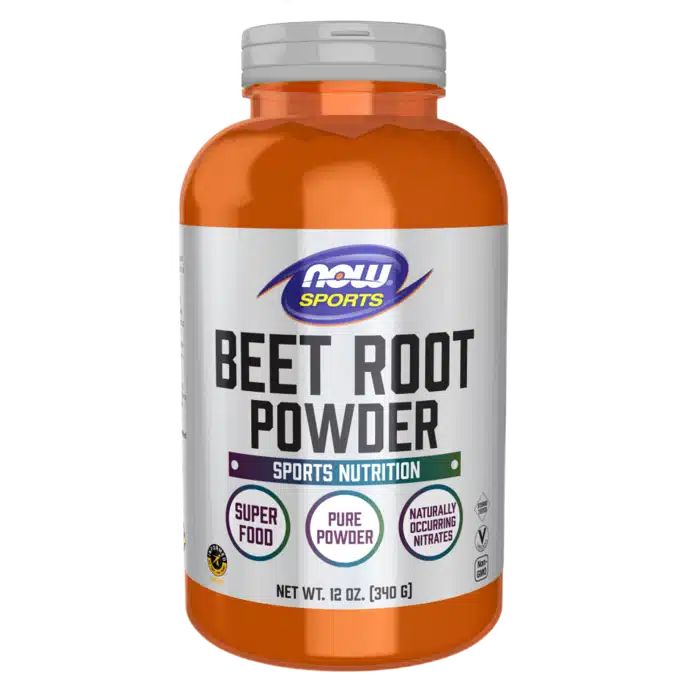
Beet Root Powder 340g - Now
Beet Root Powder 340g - Now Available in stock
Restam apenas 2 em stock
Free Shipping on orders over 30€ (Portugal Continental)
Description
Description
Beet Root Powder 340g - Now
NOW® Sports Beet Root Powder is a pure derivative of beets (non-GMO) that are dried and not extracted. Beetroot (Beta vulgaris) is a true superfood; it is a highly nutritious vegetable as it is a source of vitamins and minerals, such as Potassium, Sodium, Iron, Folic Acid, Phosphorus, Magnesium, Calcium, Vitamin C, and B-complex vitamins, such as Thiamine, Niacin, and Riboflavin.
NOW's Beet Root Powder also contains nitrates and inorganic pigments (anthocyanins, carotenoids, lutein/zeaxanthin), both of which have various health benefits. Each serving of Beet Root Powder is equivalent to 2.5 whole beets.
Beetroot has been linked to numerous health benefits, including improved blood flow, lower blood pressure, and improved performance during physical exercise.
Many of these benefits are due to its high content of inorganic nitrates (nitrates, nitrites, and nitric oxide).
The majority of dietary nitrates (80-95%) are obtained from fruits and vegetables. On the other hand, dietary nitrites are obtained from food additives, bakery products, cereals, and processed or cured meats. Several studies show that foods rich in nitrites and nitrates can have positive health effects, including the reduction of blood pressure, which decreases the risk of cardiovascular disease.
The body is able to convert the nitrates found in Beetroot into nitric oxide. This substance "travels" through arterial walls, sending signals to the tiny muscle cells surrounding the arteries, helping them to relax. When these muscle cells relax, blood vessels dilate and blood pressure drops, thus preventing hypertension.
Heart disease (heart attacks, heart failure, and stroke) is one of the leading causes of death worldwide. And high blood pressure is one of the main risk factors for the development of these conditions.
Studies have shown that Beetroot can significantly reduce blood pressure by up to 4-10 mmHg (millimeters of mercury) in just a few hours.
The effect seems to be more noticeable on systolic blood pressure (maximum value reached with the contraction of the heart) than on diastolic (minimum value when the heart subsequently expands and relaxes).
Nitrate levels in the blood remain elevated for about six hours after ingestion. Therefore, Beetroot has only a temporary effect on blood pressure, and regular consumption is necessary to experience long-term blood pressure reductions.
The nitrates present in the diet can also improve physical performance. For this reason, Beetroots are frequently used by athletes.
In two studies, it was concluded that daily Beetroot consumption over a period of six days prolonged the time to exhaustion during high-intensity exercise by 15 to 25%, representing a 1 to 2% improvement in overall performance.
Beetroot can also improve athletic performance in cycling by increasing oxygen use by up to 20%. A small study analyzed the effect of 500 ml of Beetroot juice on cycling time trial performance over 4 and 16.1 km and concluded that the consumption of this vegetable improved performance by 2.8% during the 4 km time trial and 2.7% in the 16.1 km trial.
It is important to note that nitrate levels in the blood peak 2 to 3 hours after consumption. Therefore, to maximize its potential, the ideal would be to consume Beetroots 2 to 3 hours before training or competition.
These results are due to increased blood flow to the working muscle, improved mitochondrial efficiency, and/or improved muscle contraction. There is strong evidence suggesting that dietary nitrate intake allows for increased muscle tissue oxygenation. The increase in blood flow to the working muscle allows for greater oxygen transport, which can result in more efficient metabolic control and increased time to exhaustion, thereby improving physiological performance.
Furthermore, Beetroot juice has been shown to improve mitochondrial efficiency due to greater efficiency of oxidative phosphorylation, a metabolic pathway that uses the energy released by the oxidation of nutrients to produce adenosine triphosphate (ATP).
Beetroot juice consumption also appears to decrease skeletal muscle phosphocreatine utilization and the production of adenosine diphosphate (ADP) and inorganic phosphate (Pi), indicating a reduction in the rate of ATP usage. This effect led to the conclusion that nitrate intake can alter ATP consumption rates during muscle contraction, thus prolonging the time to exhaustion.
The nitrates found in Beetroot may also improve mental and cognitive function, which tends to decline with age.
Beetroot particularly improves blood flow to the frontal lobe of the Brain, an area associated with high-level thinking, such as decision-making and working memory.
Recently, scientists discovered a complex method by which harder-working brain cells obtain even more oxygen. It is called "neurovascular coupling" and involves a complex set of cells and signaling molecules, which work together to increase blood flow to the brain cells that need a temporary boost of oxygen to function at maximum efficiency.
Recent studies have also shown that taking Beetroot before exercise can significantly reduce the so-called Cerebral Augmentation Index. This index essentially measures the undesirable stiffness of arteries in the Brain. Cardiovascular disease is typically characterized by stiffness in the arteries. When this happens in the Brain, it can affect its ability to obtain the necessary amounts of oxygen to perform more demanding tasks. A high Cerebral Augmentation Index is typically linked to cognitive decline.
The Brain and Nervous System depend on Nitric Oxide for proper functioning. A recent study showed that a dose of Beetroot juice increases blood flow to the Brain and results in measurable improvements in cognitive performance. The individuals ingested about 450 ml of Beetroot juice 90 minutes before the start of exercise.
Due to the potential effects of nitrate on blood flow, it is possible that these may increase blood flow and improve brain function, facilitating the supply of oxygen and nutrients to the Brain.
340 g powder
Specifications
Specifications
-
Nutritional information
-
Warnings
-
Dosage and administration
-
Features


